Tag: Book Recommendations

  • Review: Say You’ll Remember Me

    by Abby Jimenez

    Star Rating: ⭐⭐⭐⭐.5


    Synopsis:

    Say You'll Remember Me book

    Xavier and Samantha fall hard and fast for each other. But the day after their epic first date, Samantha leaves Minnesota to help her family take care of her mother, who has early onset dementia, in California.

    Even though they barely know each other, Xavier and Samantha can’t forget each other, and they can’t move on. And even though they know it seems like a terrible idea, they start a long-distance relationship that wears on them both financially and emotionally.

    With Xavier financially bound to his new veterinary practice and Samantha determined to be there for her family, they don’t see how they’ll ever be able to live in the same state for the foreseeable future. As hard as it is, not being together feels a thousand times worse. Can they figure out a way to make it work?


    Review:

    This was such delightful, sweet story that warmed my heart. I flew through this book in two days, which is really fast for me. There was so much I loved:

    That Xavier is a veterinarian who’s extremely passionate about animal welfare. I have such a soft spot for fellow animal lovers and so appreciate that they recur throughout Abby Jimenez’s books. 

    The idea of two people with such strong chemistry that they couldn’t stay away from each other, even though they’d only met once, lived 2,000 miles apart, and a romantic relationship didn’t make logical sense. That’s what strong love will do: push you to do things that make no sense to anyone else.

    Samantha’s family dynamic and seeing the challenges they faced dealing with her mother Lisa’s dementia. It felt so real and heart-wrenching, but also moving. I loved the way they all banded together and supported one another through the hardest, scariest moments of this disease.

    And even as Lisa’s condition worsened, they were still so determined to care for her, form their own new memories of her, and do everything in their power to give her the best quality of life they possibly could.

    The way Samantha unlocks something in Xavier and draws him out of his shell. When they first meet, he’s so closed off and even curmudgeonly as a direct result of his terrible childhood. But she gives him someone he feels like he can truly trust for the first time in a long time. He feels safe to let his guard down, be vulnerable, and experience real joy.

    It’s so sweet and hopeful: No matter what we’re going through now or what awful things we’ve experienced in the past, we can still have these magical moments with people who allow us to appreciate the beauty life can have.

    Small Quibbles:

    Say You’ll Remember Me seems like it’s been pretty divisive, with readers either loving or hating it. I’ve seen some criticize the book because they didn’t understand the connection between Xavier and Samantha.

    That wasn’t my experience, but there were times I thought Abby moved too quickly through their dates, summarizing big sections where I wish she’d slowed down and given us more fleshed-out scenes. I think more scenes would’ve gone a long to helping more readers feel Samantha and Xavier’s connection, and those of us who already did to feel it even more strongly.

    I’ve also seen at least a few readers criticize the language for using too much contemporary slang. I admit that did bug me a little. Especially early on, there were a lot of Gen z phrases (e.g. pick me, out of pocket), that didn’t necessarily feel natural to the characters. To me, it felt more like an author in their 40s trying a little too hard to relate to readers in their late teens and early 20s.

    Similarly, there were several references to the character Rhysand from Sarah J. Maas’s ACOTAR series. I love this character and I love ACOTAR, but the reference felt forced rather than organic. It would’ve been different if the characters were big readers and talked about books a lot, but they weren’t and they didn’t.

    Lastly, I felt like Samantha and especially Xavier should’ve been a little bit older. They’re 28 and 29, respectively. But Xavier has owned his own vet clinic for two years, which means he opened it at roughly age 27. Yet, vet school—according to my Google search—lasts 4 years, which means Xavier most likely would’ve finished school at about 26.

    I find it hard to believe that a year out of school, with no money to his name, he was able to secure a loan and open his own brick-and-mortar business. He should really be at least in his early 30s for his situation to feel plausible.

    But this is all just me being nitpicky. Criticisms aside, the book made me so happy and pulled me in so much, and that’s what matters most.

    I’m still working through Abby Jimenez’s books (I need to read the Part of Your World series), but so far Say You’ll Remember ranks pretty high. It’s above the Friend Zone series, and right below Just for the Summer—my current favorite.  


    Favorite Quotes:

    “You think it’s the big memories you should be chasing … But the small memories are the fabric of your life, the ones so inconsequential that you don’t even remember them. You just remember how you felt when you were making them.” (243)

    “I was willing to work harder for her than I’d ever worked for anything or anyone including myself. Loving her gave me purpose. It made me feel like I knew what my life was supposed to be about. I felt focused and calm and like a frantic search I hadn’t known I was on was over. This was what I was here to do, this was who I was here to be with.” (279)

    “I wanted the luxury of mundane cohabitation. I wanted to get sick of him. I wanted to see him so much, his bad habits exasperated me. I wanted to be so tired of his shit, I looked forward to him going out on his boy’s weekends just so I could get some alone time, and then once he’s gone, I’d miss him so much I can’t stand it and I’m miserable the whole time because he’s my best friend.” (309-310)
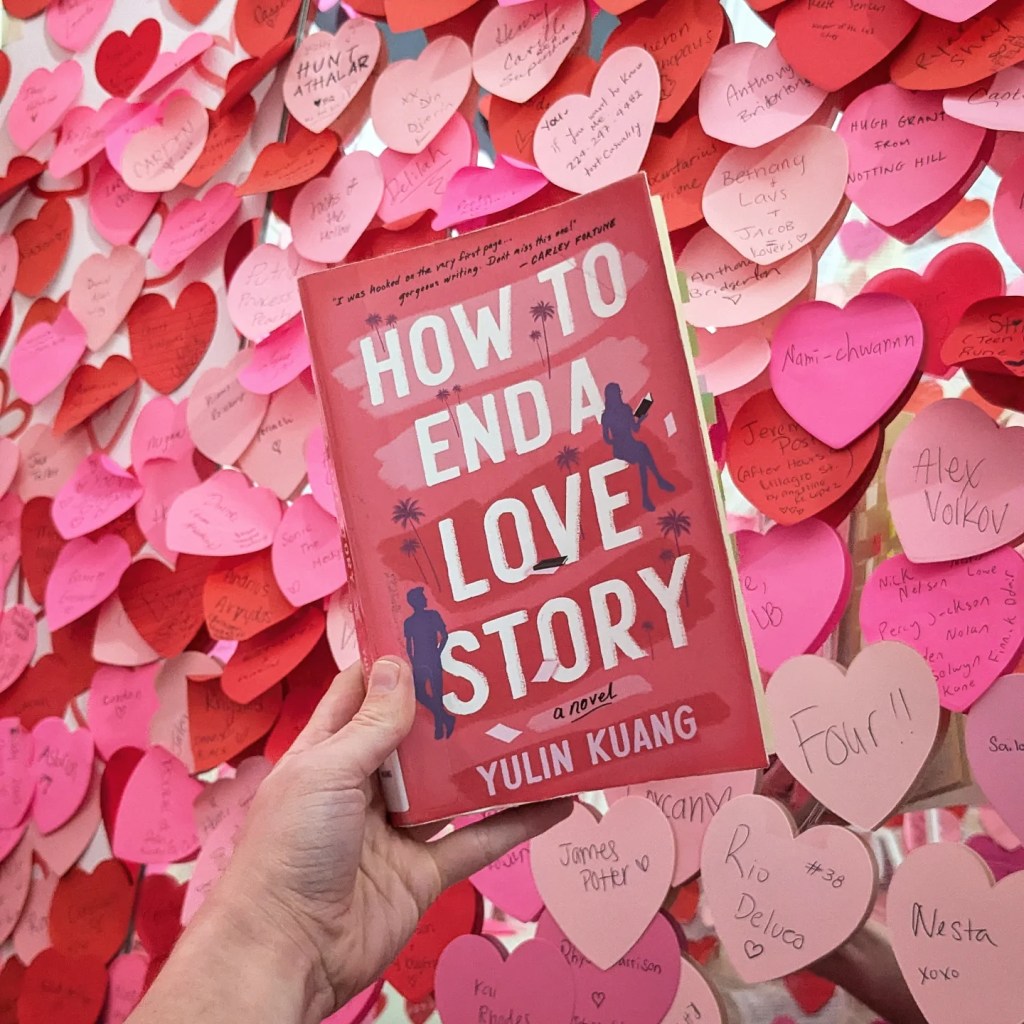
  • Review: How to End a Love Story

    by Yulin Kuang

    Star Rating: ⭐⭐⭐⭐⭐


    Synopsis:

    Helen Zhang relocates to LA to work on the TV adaptation of her YA series, The Ivy Papers. To her dismay, her staff writers include Grant Shepard, her high school homecoming king who was involved in the tragic accident that claimed her little sister’s life 13 years earlier.

    As the two learn how to untangle their pain and work together, they realize there’s something more between them. But can they have a future when they share such a traumatic past?


    Review:

    I loved this book so much! It was incredibly heartfelt and moving. Yulin Kuang somehow managed to tackle heavy subjects—ranging from PTSD to suicide—with nuance and sensitivity, while also balancing them with humor, romance, and spice. I could not be more impressed.

    I love romance books where the leads have to overcome a significant obstacle in order to be together. And my God, I can hardly think of a bigger obstacle than, “my sister killed herself by jumping in front of your car.” (This is not a spoiler; it happens in the first few pages.)

    A big obstacle not only makes for a better story, it also fills me with hope. It’s not so much the idea of love conquering it all as it is the strength of the human spirit—especially our enormous compacity for perseverance and forgiveness.

    As hard as relationships and life can be, two people—no matter how messy—can come together to work through their issues and trauma, lift each other up, and come out the other side stronger. We can even find something beautiful in the places and people we least expect it if we allow ourselves to really know them and be known in return.

    I really appreciated that How to End a Love Story largely takes place 13 years after the death of Helen’s sister, Michelle. It highlights the way emotional pain lingers. Even if you manage to make something of your life after such a traumatic experience—as Helen and Grant both do—you’ll still carry this pain with you. If you try to hide or suppress it, it will eventually try to force itself out in one way or another—Grant with his panic attacks, Helen with her anxiety and tendency to lash out.

    On the surface, it seems like there’s no way a relationship between these two people could work—Helen and her parents blame Grant for Michelle’s death, because it’s easier than grappling with her suicide. Grant himself feels debilitating guilt over her death too. And yet, no one can understand Grant’s and Helen’s pain quite like the other. I could really feel the connection and chemistry between these two characters, and I really rooted for them—their relationship as well as their respective career success and emotional wellbeing. I cannot recommend this book enough.

    I recently learned that Yulin Kuang is the screenwriter for the film adaptations of Emily Henry’s People We Meet on Vacation and Beach Read (she’s also the director on the latter). I’m a huge Henry fan, and I was a little nervous that the adaptations wouldn’t live up to my expectations. But after reading How to End a Love Story, I’m so much more excited for them! How fitting that this book was about book-to-screen adaptations. I feel confident we’re in good hands.


    Favorite Quotes:

    “I’d rather have a fraction of you than all of someone else.” (306)

    “He kisses her slowly, persuasively, as if they have all the time in the world—before he slows down the kiss that she’s already starting to call the best damn kiss of her entire life and it retreats from present tense into memory.” (187)

    “Helen has created a very special window into her life that’s just for her parents. Don’t look there, the view’s not as good, she would say, pulling the drapes over a messy fourth date, a failed situationship, a bad breakup, and a drunken night out. She stores up bad news like acorns in the winter and metes them out in small doses, when she finally has good news to soften the blow.” (109)

  • Review: Crescent City—House of Earth and Blood

    By Sarah J. Maas

    Star Rating: ⭐⭐⭐⭐.25

    Quick Take: Wonderful! Really impressive world-building filled with high stakes, fun twists, engaging mysteries, and a whole lot of heart.

    Favorite Quotes: “They were two of a kind, like she could throw anything at him and he’d catch it. Would meet every challenge with that wicked, feral grin.” (357)

    “You’re the person I don’t need to explain myself to—not when it matters. You see everything I am, and you don’t run away from it.” (556)

    “For fuck’s sake, just kiss me, Quinlin.” (590)


    I was nervous going into this book. I love Sarah J. Maas’s series A Court of Thorns and Roses, but I’ve heard from fellow fans that Crescent City (and Throne of Glass) isn’t nearly as good. That it’s light on the romance and heavy on the fantasy, and inundated with tedious, slow world-building that’s difficult to follow. This deterred me from exploring the series for a long time.

    But I was so pleasantly surprised by House of Earth and Blood. While I do think it could’ve been 100–200 pages shorter (it’s 800 total), I thoroughly enjoyed it.

    The world-building wasn’t nearly as intense as I imagined and was integrated into the narrative really well. While I initially had a little trouble keeping some things straight (like the different houses and classes), it all sank in relatively quickly and I followed it just fine overall. I actually found the societal intricacies and hierarchies pretty fascinating (and impressive).

    What I Loved:

    All the mysteries that kept me guessing. Every time I thought I figured something out, there was a fun, new twist.

    The strong friendship between Danika and Bryce. The book really revolves around their connection and love for each other. It really hits home the value of platonic love, how it can be just as powerful and meaningful as romantic love.

    The unconditional love between Bryce and her brother Ruhn. Their relationship is the way I want familial bonds to be—even when you drive each other crazy, even when you piss each other off, you still love each other and would do anything you could to protect one another.  

    The slow burn romance and deep connection between Bryce and Hunt, and the idea that second love can be just as powerful as first. They both lost people they loved, knew what it was like to be othered and treated as less than, and understood the anger that belied the deep-seated pain they each harbored. And they came to accept each other fully, rough edges and all.

    Sidenote for ACOTAR fans: Bryce and Hunt reminded me of a slightly less intense version of Nesta and Cassian in A Court of Silver Flames.

    The messy, complicated characters, especially Bryce and Hunt. Maas is so good at writing people coping with trauma and going through all the stages of grief. Notably, using anger as a shield before finally allowing themselves to fully experience their pain. Bryce’s journey to accept what is and ultimately love and trust both herself and others again is so emotionally satisfying.

    The other things I loved, as well as the majority of my criticisms, get into spoiler territory, so if you haven’t read this book yet, stop here!


    ***SPOILERS AHEAD!***

    I went into this book blind, and I’m so glad I did. I was truly shocked when Danika and Connor died fairly early on. I expected Danika to be Bryce’s sidekick throughout the book, and Connor to be her primary love interest. It made me all the more excited to keep reading and figure out where the book would go after such a surprising, horrific event.

    I was also legitimately surprised when archangel Micah turned out to be the book’s ultimate villain. I’d been convinced that he was if not good, at least decent and principled. When he showed up at the antiquities shop where Bryce works, I was sure he was there to help her figure out how to free Hunt. When he reveals that he was behind the horrendous crimes of the novel, it was surprising but also made sense—which is how a twist should be.

    Some Small Qualms:

    • I was heartbroken when the fire sprite Lehabah died, sacrificing herself to save Bryce. The heartbreak itself isn’t a problem—I want a story to make me feel things—but it bugged me that an enslaved character who had literally nothing died for the book’s hero. I would have preferred a character with more power and autonomy—such as the sorceress Jesiba, Bryce’s domineering and irascible boss—to make that kind of sacrifice.
    • Hunt’s secret plan to use synth for another uprising stretched credulity for a few reasons.
      1. He sneaks out in the middle of the night to buy synth on a barge in the middle of the river without Bryce knowing. Yet, he, was in agonizing pain from his wings being cut off, and could barely walk hours earlier. How is he physically capable of pulling off this caper?
      2. We get Hunt’s POV so often throughout the book that it doesn’t make sense we wouldn’t know what he was up to. We should’ve at least gotten more clues so it didn’t come as a total shock. It felt a little cheap and purposely obfuscating rather than organic. 
    • At the summit at the end of the book, everyone watches Bryce fighting for her life on the video feed for far too long before jumping into action. I know the summit was far away from Crescent City, but they could’ve gotten off their asses sooner to try and help her. It was also a little irritating seeing so much of Bryce’s experience filtered through this lens. We could’ve stayed with her for the majority of this section.
    • I do wish there was a little more time spent on the romance between Hunt and Bryce given how long the book is, but that’s more on me, being a bigger fan of romance than fantasy. That said, I do wish it hadn’t taken 500 pages for anything to happen between them, and it’s absolutely infuriating that every time they started to get physically intimate, they were interrupted. Every. Damn. Time. We should’ve at least gotten one uninterrupted scene at the end of the book.

  • Review: Wild Love

    by Elsie Silver

    Star Rating: ⭐⭐⭐.25

    Quick Take: Overall an entertaining, sexy read with a lot of fun banter, but a little longer than it needed to be.

    Favorite Quotes: “Rosie, I’m a grown-ass man. Your period doesn’t scare me.” (275)

    “I definitely don’t hate you, Rosie. Not even close. But I can fuck you like I do if that’s what you need.” (302)


    What I Loved:

    The flirtatious teasing and banter between the main characters, Rosie and Ford, especially in the first half of the book. Their jabs at one another felt like good-natured ribbing, rather than anything with true animus behind it. I particularly loved the quippy work emails they’d send one another—these were some of the funniest moments in the book.

    That Ford carried a torch for Rosie for over a decade. In male-female romance books, I always love when the man has been in love with the woman for years, especially when she’s misconstrued his feelings, thinking he was disinterested or annoyed by her. But really, that disinterest or irritation is the guy’s way of hiding feelings he fears are unacceptable or unwanted.

    The slow burn followed by steamy sex scenes. I’ll say this for Silver: she really does know how to write a good sex scene. And I love a good sex scene all the more when I have to wait for it—the tension just builds and builds between the characters until it boils over.

    On a related note, I so appreciate that Rosie and Ford don’t have penetrative sex right away. In a lot of romance novels, the characters end up having sex the first time they kiss. There’s nothing wrong with that, it’s just not as tantalizing or satisfying, in my opinion.

    What I Didn’t Love:

    After Rosie and Ford finally get together, their good-natured teasing turns meaner. This was the opposite of what I’ve seen in many enemies-to-lovers novels, where initial cruelty turns more playful once the characters actually acknowledge their feelings for each other.

    I hate it when fighting and cruelty are conflated with passion. Initially, I was so excited that this book seemed like it was going to flip this trope on its head, and was disappointed when it didn’t. I wish Silver had kept the initial lightness to Rosie and Ford’s banter, but as it went on, I felt like these characters seemed to bring out the worst in each other.

    Some really important secondary characters and subplots got overshadowed and didn’t receive nearly as much page space as they deserved.

    Most notably, Rosie’s brother West, who also happens to be Ford’s best friend. Their fear of upsetting West is supposed to be one of the primary reasons that Ford and Rosie are reluctant to get together. But West is barely in this book! He deserved to be in it much more, and the novel would have been more satisfying for it.

    Sometimes the language felt inauthentic to the characters. I noticed this with Rosie’s diary entries from high school—they often didn’t sound like they’d been written by a teenager. (That said, I did really enjoy the inclusion of her diary entries overall, and the way they gave us more insight into Rosie and Ford’s dynamic as teens.)

    The language felt most inauthentic to me reading Ford’s POV. His language turned flowery and poetic at times as he described the setting in depth. It felt totally inconsistent with his character. The worst offender:

    “The smell of lilacs permeates the air, emanating from the bush behind us, while the minerality of the lake water beside us adds a soft undertone.” (211)

    I know I criticized quite a few things, but I’ll say this: I liked the parts I liked more than I disliked the parts I disliked. And most of my critiques are me being nitpicky. This is an incredibly popular book and series, beloved by many romance readers. Wild Love definitely piqued my interest in Elsie Silver as an author and I plan to read more by her.

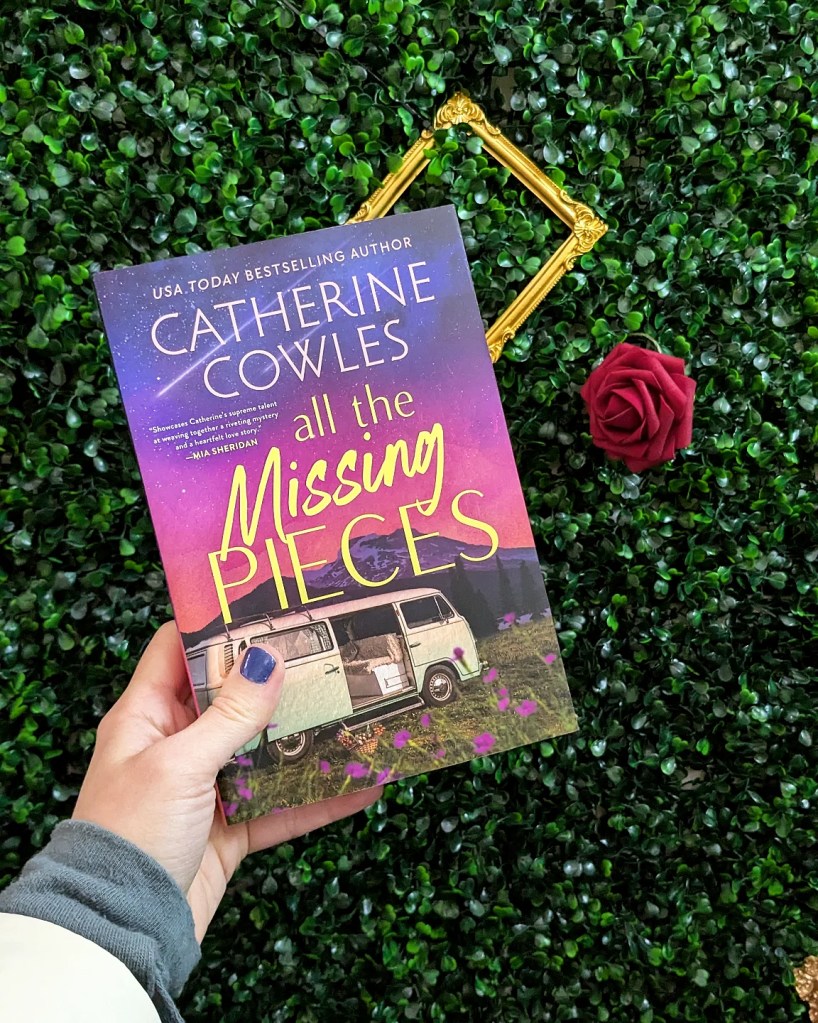
  • Review: All the Missing Pieces

    by Catherine Cowles

    Star Rating: ⭐⭐⭐⭐

    Quick Take: Loved! A super engaging story that has a little bit of everything—crime, romance, tragedy, humor. It also combines one of my favorite romance tropes—enemies to lovers—with a good mystery.

    Favorite Quotes: “Be safe, Chaos. It’s going to piss me the hell off if you end up dead.” (212)

    “If I break my neck pulling this ridiculous stunt, I’m going to haunt your ass.” (266)


    I loved this book! It has a little bit of everything—crime, romance, tragedy, humor. It also combines one of my favorite romance tropes—enemies to lovers—with my love of a good mystery. It kept me guessing until the end. I lay awake at night trying to solve it, and I couldn’t.

    I worried this meant that the big reveal might be a let down with a completely left-field perpetrator, but it wasn’t. The answer made sense in the world of the novel and was all the more satisfying since I couldn’t guess it.

    Brief synopsis: Losing her twin sister compels Ridley Sawyer to become a nomadic true-crime podcaster, driving her camper van around the country in the hopes of helping solve cold cases that are similar to her sister’s disappearance—and that she suspects could be connected. When she arrives in Shady Cove for her next assignment, she’s met with resistance from the small, tight-knit community, and her biggest detractor is the town’s smoking hot sheriff, Colter Brooks.

    With the growing popularity of true crime in recent years and the heated debate around its ethics, I loved the way the book handled this contentious topic with such care, openness, and thoughtfulness. In short, there’s a right way to do true crime that can bring communities together, find justice for victims and their families, and potentially pave the way for healing. There’s also a wrong way to do true crime, which exploits these tragedies for personal and financial gain and in the process, dehumanizes victims and their families while forcing them to relive the worst moments of their lives.

    In All the Missing Pieces, the community of Shady Cove is suspicious that Ridley falls into the latter category, that she’s only digging into the town’s painful history to get more followers for her podcast and boost her own popularity. But one by one, they see how passionate Ridley is about justice, and that the purpose of her podcast is to garner enough interest in cold cases to uncover new, previously missed details that could be the key to solving them. In doing so, Ridley hopes to give families closure and stop the perpetrators of these crimes from hurting anyone else. The community bands together behind her, especially when they learn that Ridley’s own sister was kidnapped and never found. The book nearly had me in tears several times as Ridley confronted her trauma and helped Colt do the same.

    The only reason I didn’t give this book five stars is because I often found the language lacking. While there were some good quips throughout, the novel had a lot of sticky sentences the editor in me itched to simplify. There were also several chapters that ended with hokey and maddening cliff hangers. I’m not against cliff hangers in general, only when they’re used to trick the audience into thinking something terrible is about to happen (e.g. Ridley thinks someone is hiding in her closet waiting to attack her, but turns out it was just her cat).

    My last main critique is that some of the sex scenes felt logistically absurd (they’re standing in the middle of a room and he’s holding her with one arm, really?). But I can hardly hold it against Cowles when this is a recurring issue I see in many romance books, and the scenes were still sexy and fun.

    Overall though, All the Missing Pieces tells a super engaging story that manages to be both incredibly moving and a lot of fun. I’m definitely interested in reading more by Cowles.

    I’m really hoping for a spinoff with two of the secondary characters (I won’t say who to avoid any spoilers). And I think there’s a good chance we’ll get one. Cowles sets it up perfectly.

  • Review: The Rose and the Yew Tree

    by Mary Westmacott (aka Agathie Christie)


    Star Rating: ⭐⭐⭐⭐⭐

    Quick Take: Absolutely stunning. A provocative meditation on life, love, worry, what it means to be a person in the world, and whether there are new possible ways to navigate it that we’d never considered.  

    Favorite Quote: “You really loved her. You loved her enough to leave her alone.” (p. 245)


    After hearing that Agathie Christie wrote romance novels under the pseudonym Mary Westmacott, I immediately checked out one of these books: The Rose and the Yew Tree, first published in 1947 by Arbor House.

    It’s definitely not a romance, but I’m still including it in my romance recommendations because it is about love and obsession and relationships, subjects I imagine interest many romance readers.

    I was truly surprised by how much I loved this book—it’s one of the best I’ve read in the past few years. I didn’t really know what to expect going into it, having only read Christie’s detective novels. While I enjoyed many of them, they never truly captivated me, and they certainly never moved me the way The Rose and the Yew Tree did.

    This novel gripped me pretty much from the beginning, with its acerbic wit juxtaposed with stunning insights on love, life, and death. It somehow manages to be incredibly funny as well as beautiful and tragic. It has everything.

    HarperCollins (which later republished the book) provides this synopsis: “Everyone expected Isabella Charteris, beautiful, sheltered and aristocratic, to marry her cousin Rupert when he came back from the war. It would have been such a suitable marriage. How strange then that John Gabriel, an ambitious and ruthless war hero, should appear in her life. For Isabella, the price of love would mean abandoning her dreams of home and happiness forever. For Gabriel, it would destroy his chance of a career and all his ambitions!”

    To me, this synopsis fails to capture the book’s essence. It completely leaves out the narrator, Hugh Norrey, who himself becomes enchanted by Isabella. Hugh relocates to the country with his brother and sister-in-law after a terrible car accident destroys his ability to walk, have sex, or do much of anything for himself. Hugh is drowning in self-pity and despair when he meets Isabella, but as he gets to know her, he rediscovers his will to live again. Through him, we get provocative meditations on what it means to be a person in the world and whether there are new possible ways to navigate it that we’d never considered.  

    It was Hugh’s experience and reflections that stuck with me and stood out more than any romantic encounter between Isabella and John Gabriel. While they both feature prominently in the book, it’s primarily through their respective relationships to Hugh. Their own tryst doesn’t even come up until the book is nearly over.

    What captivated me most about The Rose and the Yew Tree were Christie’s incredibly vivid, specific, and authentic character portraits. It was these portraits that propelled the book forward more than plot, which I believe categorizes the book as literary fiction more than anything else.  

    For me, so much of this book is a meditation on worry—the futility and perhaps even the self-indulgence of it. It’s not just that worry can prevent us from enjoying life; worry can also impede us from really seeing the world around us and the people in it. We instead see them filtered through our own experience rather than their own, putting ourselves at the center of other people’s lives.

    The book is also a mediation on love and what it means to truly care for someone. It’s not about obsession or passion or lust. It’s about seeing them for who they really are and not just accepting them, but appreciating them for it. Allowing them to live their life the way they see fit, even if that means that you’re not a part of it. And in the world of The Rose and the Yew Tree, loving someone so purely can bring its own kind of happiness.

    I can’t remember the last time I flagged so many quotes from a book. Here are a few of my favorites:

    “I’ve always suspected that a sense of humor is a kind of parlor trick we civilized folk have taught ourselves as an insurance against disillusionment. We make a conscious effort to see things as funny, simply because we suspect they are unsatisfactory.”(Arbor House first edition, p. 175)


    “We, all of us, use imagination and speculation as a means of escape—a way of getting outwards, away from ourselves. Isabella doesn’t need to get away from herself. She can live with herself—she’s in harmony with herself. She has no need for a more complex way of life.” (p. 119–120)


    “Is there any bitterness like the bitterness of a fool’s paradise? All that communion of mind with mind, our thoughts that leapt to complete each other, our friendship, our companionship: illusion—nothing but illusion. The illusion that mutual attraction between man and woman breeds. Nature’s lure, Nature’s last and most cunning piece of deceit. Between me and Jennifer that had been the attraction of the flesh only—from that had sprung the whole monstrous fabric of self-deception. It had been passion and passion only, and the discovery shamed me, turned me sour, brought me almost to the point of hating her as well as myself. We stared at each other desolately—wondering each in our own way what had happened to the miracle in which we had been so confident.” (p. 27)

  • Review: Tangled Up In You

    by Christina Lauren


    Star Rarting: ⭐⭐⭐.75

    Quick Take: A little silly and even at times absurd, but overall really fun and entertaining, with two romantic leads who truly bring out the best in each other.

    Favorite Quote: “Observing the world through Ren’s eyes made Edward realize how often he didn’t really pay attention to what was going on around him. He moved through life constantly on the offense and went into every interaction with an objective. It meant he missed the details, missed the moments that made life worth living.” (p. 226)


    This contemporary romance novel centers on Ren, a sunny 22-year-old who’s spent her life largely isolated from the world on a farm with her controlling parents. When she leaves to go to college—her first time ever going to school—she meets Edward (aka Fitz), her sexy, guarded classmate with a secret criminal record he’s trying to expunge.

    When they embark on a cross-country road trip together over spring break, Fitz shows Ren the wonders of the wider world, while she shows him the beauty of navigating that world with an open heart.

    Truthfully, I was a bit lukewarm on this book at first. Ren’s innocence and naivety initially made her feel incredibly young—to the point where she felt even felt like a child, so I couldn’t picture her as a love interest, nor did I want to. It also took the sexual tension much longer to really surface than I typically prefer from romance novels. But once Ren’s childlike innocence began to fade and she really began to embrace her sexuality and attraction to Fitz, I was hooked and couldn’t put the book down. Ren and Fitz really brought out the best in each other and balanced one another so well.

    I also really appreciated and enjoyed how incredibly smart, strong, and capable Ren was. There were so many things she could do that Fitz couldn’t, from recovering their stolen wallets to fixing their broken-down car. Rather than feeling defensive and insecure, Fitz just admired and respected her for it. I loved that dynamic and how it upended gender stereotypes.

    Without spoiling anything, I’ll acknowledge that some of the plot points felt a little ridiculous and really stretched the bounds of credulity, but you know what? It was fun and I’m here for it. I did wish the ending went on a bit longer—I would’ve loved a full-on epilogue. Without it, the ending felt a tad rushed. This and the slow start prevented me from rating the book four stars, but overall this was such a fun and entertaining read with a lot of heart.

    Fun fact: The novel was inspired by Tangled. I didn’t realize this until reading the acknowledgements, but now that I know, it makes so much sense.

  • Review: Angelika Frankenstein Makes Her Match

    by Sally Thorne


    Star Rating: ⭐⭐⭐⭐

    Quick Take: Sizzling chemistry, delightful banter, compelling obstacles, full of heart.

    Favorite Quote: “Angelika Frankenstein knew what physical qualities her ideal man should have; unfortunately, she had to find those attributes at the morgue.”


    Sally Thorne wrote Frankenstein fanfiction during the pandemic, when she, like so many of us, felt overwhelmed, drained, and creatively tapped.

    I love the idea of borrowing beloved characters to break out of a writing slump.

    But I was initially reluctant to read Angilika Frankestein Makes Her Match.

    It seemed like a far cry from Thorne’s contemporary romances The Hating Game and Second First Impressions, both of which I love. And yet, even with the historical time period, the sci-fi elements, and the high concept, Angelika Frankenstein is still somehow classic Sally.

    The leads share sizzling chemistry and delightful banter, while facing truly challenging and compelling obstacles to their relationship (a very clear one being that Angelika resurrected her romantic interest, Will, after discarding most of his body in favor of other dead men’s body parts). Through it all, this book is full of heart.