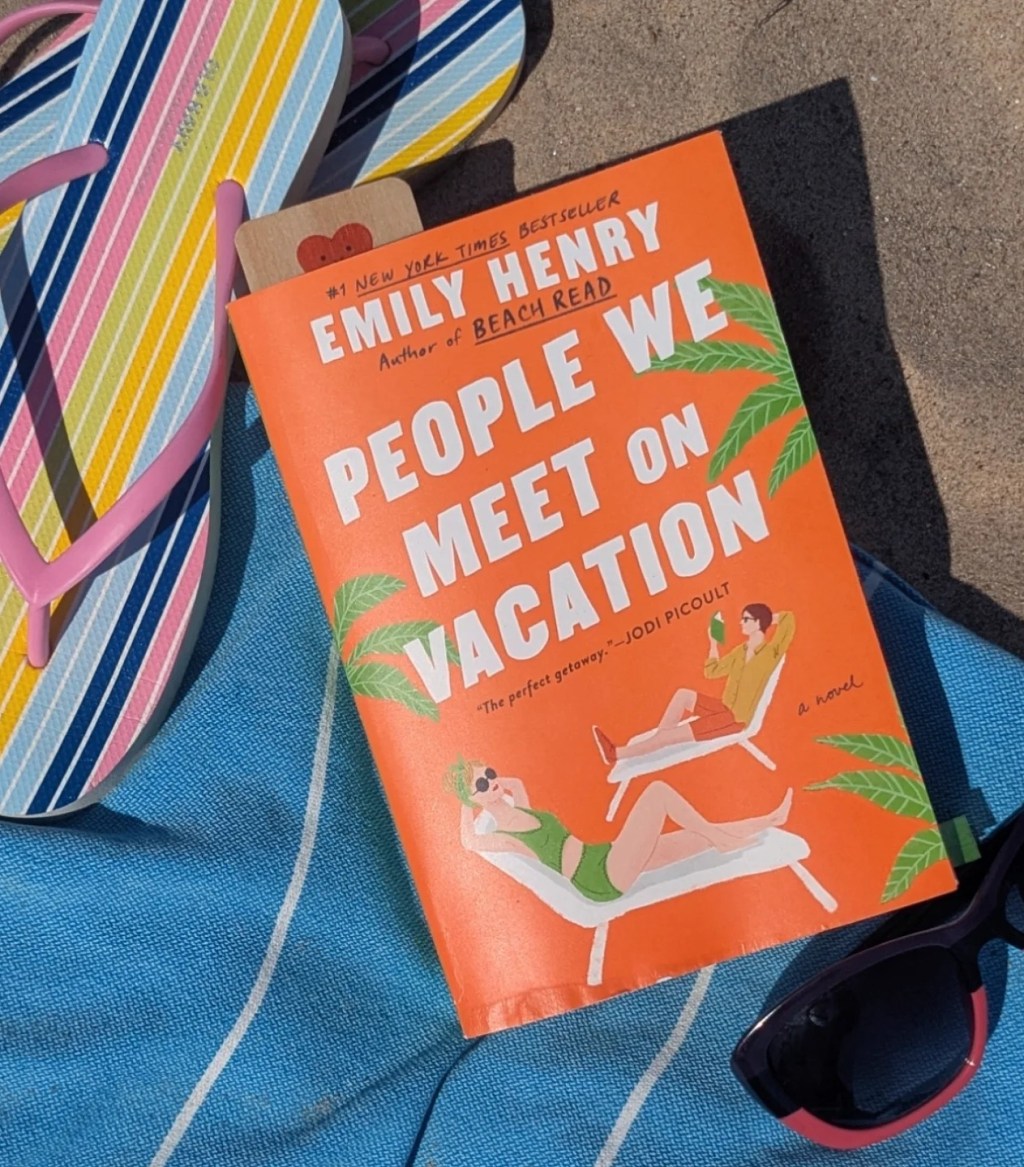
Tag: emily-henry

  • Book Review: People We Meet on Vacation

    Book Review: People We Meet on Vacation

    by Emily Henry

    Star Rating: ⭐⭐⭐⭐.75


    Synopsis:

    On the surface, Poppy and Alex seem like polar opposites: She’s an outgoing free-sprit with insatiable wanderlust. He’s an uptight, responsible introvert and homebody. Yet, they become the best of friends during college. They make a pact to take a vacation together every summer.

    They keep their pact for ten years, until they have a falling out after a confusing trip to Croatia. Now, two years after that trip, Poppy is in a rut and desperately misses Alex. When she learns his brother is getting married in Palm Springs, it feels like the perfect opportunity for one last vacation to try to fix everything the most important relationship in her life.


    Review:

    This was my second time reading Emily Henry’s People We Meet on Vacation and I still love it!

    I adore Alex and Poppy as individual characters and as a couple. They have such a great dynamic, the way the make each other feel safer and more uninhibited than they’ve ever felt before. I love that they bring out such fun, silly sides in one another, inventing characters and stories when they’re on vacation. And my God, the banter is top notch.

    I also appreciate Poppy and Alex’s parallel character arcs, that they’re both desperate for belonging and trying to find where they fit in the world. They’ve both always felt a little like outsiders in their own families, as much as they loved them. This is what really draws them together and makes them feel so connected on a deep level, despite all their outward differences. When they’re together, they both finally feel seen and like they belong, like they’re finally someone else’s main, number-one person.

    The present-day storyline—a budget vacation to Palm Springs—is absolutely perfect. In particular, the pressure cooker that’s created by Alex and Poppy being trapped in a tiny, excruciatingly hot studio, especially at a time when their relationship has become so fragile. The tension between them was fantastic and perfectly sets them up to finally confront their issues and long-repressed feelings head on.

    My only real criticism is that I wanted to stay in this present timeline more. The book frequently oscillates between the past and present as we track the trajectory of Alex and Poppy’s relationship, from their first meeting as undergrads at the University of Chicago, to each summer vacation they take together. I did really enjoy seeing these vacations and exploring so many different cities with Alex and Poppy. But we see roughly ten summer trips, and, after a while, they start to feel a little repetitive. Not much changes about their relationship for several summers in a row.

    Poppy keeps reiterating that for years, there was only ever a 5-percent “what-if” question about her and Alex having a romantic relationship. They remained pretty firmly platonic for so long, that there was little-to-no sexual tension for a long time. I feel like Emily Henry could’ve cut a couple of these trips and we wouldn’t have lost any understanding of Poppy and Alex’s relationship. At the same time, it would’ve heightened the tension between them and given the story greater momentum. Still, it’s a pretty minor criticism and barely knocks down the star rating for me.

    A quick sidenote: My introverted, book-loving, homebody self would not be able to handle Poppy and Alex’s activity packed, sleep-deprived vacations where they constantly engage with strangers! I loved to experience them vicariously, but perhaps this is why their Palm Springs vacation speaks to me most strongly—it’s by far the most relatable.

    Check out my review of the film adaptation »


    Favorite Quotes:

    “I love when you get weird,” I tell him.

    He squints tipsily at me as we walk. “You make me weird. I’m not like this with anyone else.”

    “You make me weird too.” (172)

    “When I was a kid, I used to have these panic attacks thinking about how I could never be anyone else. I couldn’t be my mom or my dad, and for my whole life, I’d have to walk around inside a body that kept me from every truly knowing anyone else.  

    “The fear lessened, but the feeling never went away. Every once in a while, I’d roll it back out, poke at it. Wonder how I could ever strop feeling lonely when no one could ever know me all the way. When I could never peer into someone else’s brain and see it all.” (182)

    “I would rather have one tiny sliver of him forever than have all of him for just a moment and know I’d have to relinquish all of it when we were through.” (212)

    “I’ve never really felt alone since I met you. I don’t think I’ll ever feel truly alone in this world again as long as you’re in it.” (218)

    “You asked me who I was, and—it was like the answer came out of nowhere. Sometimes it feels like I didn’t even exist before that. Like you invented me.” (219)

    “Don’t encourage people to blame you for something beyond your control.” (242)

    “You can love someone and still know the future you’d have with them wouldn’t work for you, or for them, or maybe even for both of you.” (280)

    “I don’t know how to love someone as much as I love you,” he says. “It’s terrifying. And I get these bursts of thinking I can handle it and then I think about what it will do to me if I lose you.” (303)

    “It’s not your job to make me happy, okay? You can’t make anyone happy. I’m happy just because you exist, and that’s as much of my happiness as you have control over.” (303)


  • Movie Review: People We Meet on Vacation

    Movie Review: People We Meet on Vacation

    ***This review contains mild spoilers and discusses the book the film is based on some detail.***


    People We Meet on Vacation by Emily Henry is one of my favorite books. I’ve read it twice and plan to read it again. So I was beyond excited for the film adaptation, literally had trouble sleeping the night before its release like a kid on Christmas Eve. I knew my expectations were impossibly high and I needed to level set them. Still, I couldn’t help being disappointed.

    There was so much about book Poppy and Alex’s lives that was absent from the film. Like how Alex being withdrawn and uptight has a lot do with his mom dying when he was a kid. His dad was largely checked out after that, and Alex felt like he had to step up to help care for his brothers. This also makes him reluctant to get romantically involved with someone he cares about as much as Poppy, because he feels like his mom’s death destroyed his father and he’s afraid of going through that too.  

    And the reason Poppy has such intense wanderlust and is afraid to settle down—in particular in her hometown of Linfield, Ohio—is because she was teased and bullied throughout high school. She was made fun of not only for being “porny Poppy”—which the movie does, briefly, bring up—but also for the loud way she dressed and her eccentric parents, who were borderline hoarders. When she brings a boyfriend home, she’s devastated when he ridicules her family. It makes her afraid to be completely vulnerable and open up her whole life to someone else, believing no one will ever fully accept her.

    I would’ve loved to see both of their families in the movie more, and especially to see Poppy and Alex with each other’s families. I understand that you can’t fit everything into movies with tight runtimes, and these types of nuanced emotional backstories are difficult to transcribe to film. But it did the leave the characters and their arcs feeling underdeveloped.

    I was also disappointed in the changes to Poppy and Alex’s falling out. In the book, they actually go on one more solo vacation together after the awkward couples trip to Tuscany. Now single, they travel to Croatia, their friendship a bit shaky as their repressed feelings for another bubble closer and closer to the surface. One night they’re hanging out in the hotel room and end up making out. After, their insecurity about what it means to the other person drives a wedge between them. In the movie, this kiss never happens. There’s only an almost kiss, which is far less impactful and their subsequent falling out makes less sense.

    What bothers me most was that pretty much the entire present-day timeline was changed. In the book, Alex’s brother gets married in Palm Springs. Desperate to go and repair her relationship with Alex, Poppy pitches a Palm Springs story to her magazine editor. When her editor passes, Poppy instead takes time off work but lies to Alex to lure him on vacation with her again before his brother’s wedding.

    She tells him she’s writing a piece for work about budget travel (because she can’t personally afford the luxurious accommodations her company normally pays for). The trip is a disaster as they’re thrown one curveball after another. Poppy rents a cheap car that’s on its last legs and the two drive to disappointing tourist attractions around the city, with the awkwardness of their damaged friendship looming over them the whole time.

    They end up staying in a cramped, overheated motel room with a single bed (despite being advertised as having two). Alex sleeps on a tiny chaise lounge that causes his back issues to flare up and renders him virtually immobile, keeping them trapped in the ridiculously hot room for far too long. It acts as a pressure cooker, making Poppy and Alex more and more uncomfortable until they burst and finally confront their issues. It was so perfect and my favorite thing about the book.

    While Alex’s back issues briefly come up in the movie, they don’t make as much as sense without the horrible sleeping arrangements, and they’re not nearly as debilitating. The broken air conditioner also comes up, but it doesn’t have the same effect, since Poppy’s room in the movie is huge and airy and Alex isn’t even planning to stay with her.

    I desperately wish this nightmare budget vacation was in the movie. Even if they couldn’t do Palm Springs, I wish they’d picked another city where Poppy could’ve planned a crappy trip on shoestring budget.

    I also have to say that I never quite felt the connection between Poppy and Alex in the movie. Their relationship felt a little underdeveloped. The backstory omissions and the changes to the present-day storyline definitely contributed to this. Also the fact their vacations were drastically cut down from the book. Maybe the movie needed a few montages to show more trips as well as Alex and Poppy getting closer and closer over the years.

    Despite my many criticisms (some which I didn’t even bother getting into here), I didn’t hate the movie. There were many moments I enjoyed and that even made me laugh. My favorite probably being when Poppy impulsively buys a ridiculously heavy wooden sculpture at an artisan craft fair, which she and Alex (mostly Alex) then have to lug throughout the Canadian wilderness. I also thought the performances were good overall, and that Emily Bader and Tom Blyth were well cast as Poppy and Alex.

    I did try to divorce the movie from the book and assess it as its own piece of art. Even so, I think the movie was middling at best. It lacked the emotional depth and potent chemistry I want from a good romance. It also had a few too many cheap, cliched jokes that I’ve seen in countless other romcoms. I just don’t find a grown man running naked around the woods all that funny.

    Overall rating: 3 out of 5

    Check out my review of the book »

  • Review: Great Big Beautiful Life

    by Emily Henry

    Star Rating: ⭐⭐⭐⭐


    Synopsis:

    Alice is an upbeat optimist who writes celebrity profiles. Hayden is a chilly Pulitzer-Prize winning biographer. The two collide when they both arrive on a small island in Georgia to compete for the same job:

    Writing the biography of Margaret Ives, a reclusive heiress now in her eighties who was once known as “The Tabloid Princess” before she disappeared decades ago.

    Alice and Hayden don’t know why Margaret suddenly wants to emerge from her life of anonymity after all these years, but they want to find out almost as much as they want to write her life story. While they try to figure out what she’s playing at, they discover an undeniable spark between them.


    Review:

    I keep hearing how this book is so different from Emily Henry’s other novels, but I didn’t feel that way at all. Great Big Beautiful Life felt like classic Henry to me. Her writing style is the same, and I found so many traces of her other books. Notably:

    • People We Meet on Vacation: Alice and Hayden reminded me of Poppy and Alex with their grumpy/sunshine, opposites attract dynamic. Both women are bubbly, chatty, and outgoing, while the men are quiet, reserved, serious, and contemplative.

    • Book Lovers: Though the dynamic is a bit different, Alice and Hayden working on the same biography was reminiscent of Nora and Charlie editing their mutual client’s novel together.
    • Beach Read: Alice and January have so much in common: They’re both writers struggling with the loss of their father. They both fall for acclaimed writers who they worry don’t take their work seriously. And they both grew up with a sick family member, which made them each feel like they always had to put on a brave face to make everyone else feel better and not be a burden.

    Without giving too much away, I’d also like to point out that a cult called comes up at some point in GBBL—the People’s Movement for Metaphysical Healing—which calls to mind the New Eden cult that Gus writes about in Beach Read. We even follow Gus and January as they interview former cult members and their famlies—just as we watch Alice interview Margaret.

    Even the “story within a story,” which most people seem to point to as the major departure for Henry, didn’t feel like a big leap for me. Most of Henry’s main characters are either writers or professionals working in the world of books. And while it doesn’t go nearly as in depth as GBBL does with Margaret’s story, Book Lovers spends a fair amount of time on Dusty’s novel Frigid . In Beach Read, we learn a lot about the novels Gus and January are writing: The Cup is Already Broken andThe Great Family Marconi, respectively (all of which are, arguably, mini stories within a larger story).

    To be clear, I’m not criticizing GBBL for its overlap with Henry’s other books. It’s normal for writers to revisit similar themes and ideas. If anything, I feel like I kind of know Henry a little bit now and have a better understanding of what her preoccupations are. And I think she’s been setting herself and her readers up for GBBL for a long time.

    I really liked GBBL overall, especially the ending, which I’ve seen a fair amount of criticism of. But to me, everything came together in a really satisfying way. I won’t say more than that to avoid spoilers.

    I also enjoyed Margaret’s story quite a bit, with its explorations of inherited trauma, parasocial relationships, and fractured identities. I know this story within a story has been divisive, with some finding it tedious and boring. Admittedly, it moved a bit slower at times than the romance plotline and required a bit more patience, but I don’t fault it for that. This, I think, is the biggest departure for Henry with GBBL: She asks us to be patient and slow down for a minute, which romance books (including Henry’s past ones) don’t often ask us to do.

    My only real issue with GBBL was that we jumped into the romance between Alice and Hayden too quickly, before I felt really invested in them as a couple. Perhaps ironically, I wish Henry had slowed this part down too. But I did ultimately enjoy their love story and rooted for them in the end.

    I’m not sure yet where GBBL ranks for me among Henry’s books. It’s not my favorite of hers, but it was still compelling and I’ll definitely reread.


    Favorite Quotes:

    “When you love someone, you do anything to give them what they need. You unmake the world and build a new one.” (410)

    “I want to be with you. Nothing else is going to matter to me more than that. Not at the end of my life. Not even now. Nothing will matter more than who I spent my time with, and I want it to be you. I need it to be you.” (411-412)